Posts

It's Valentine's ❤️

Image
It's Valentine's and this week's post is all about ❤️ ❤️ ❤️  Fun fact of the week Image modified from Glenn et al., 2010 Mosquitoes have an elongated tube-shaped heart spanning their body length. A mosquito has a heart rate of about 82 beats per minute pumping its blood towards the mosquito's head, but sometimes in a reversed direction towards the tip of its abdomen. About the image: Hillyer Laboratory at Vanderbilt University published an extensive study on mosquito cardiac system. The image here shows the heart tube running along the mosquito's abdomen. Here, muscle fibers are visualized by a green fluorescent dye. There is a network of muscle spiraling along the heart tube (blue arrows). The triangular bundles of muscles serve to anchor the heart to the mosquito 's back (red arrows).   More about this cool study at: Glenn JD, King JG and Hillyer JF (2010). Structural mechanics of the mosquito heart and its function in bidirectional hemolym...

A mosquito walks into a bar...Bartender: What would you like? Mosquito: A bloody Mary

Image
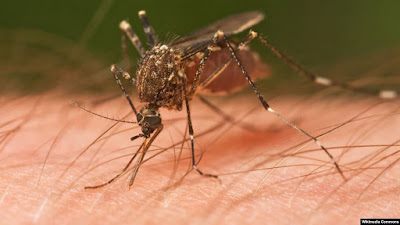
Fun Fact of the week Don't for get to bring mosquito repellent to your next summer bbq. Photo by KaLisa Veer on Unsplash Those last couple beers at your summer cookout might make you more delicious to mosquitoes! Studies from Japan and West Africa showed that beer consumption made the volunteers more attractive to mosquitoes. Although beer consumption is associated with higher frequency of mosquitoes landing on your skin, these studies found that increased alcohol content in your sweat or CO 2 in your breath did not correlate with the volunteers' increased attractiveness to mosquitoes. The exact cause of why mosquitoes are more drawn to you after a few brewskies is still up for debate. Sidenote: A Bug's Life. Pixar Picture Twenty+ years later, I've just got this joke from Pixar. He* ordered Bloody Mary O+ !!! Ok not that I would know what a bloody Mary was when I was a preteen. *Let's not get into the details of the fact that only female mosquito...

What do you call a mosquito on vacation? An itch-hiker.

Image
Fun Fact of the Week, A mosquito embedded in Amber. Not the mosquito in question. Image for illustration purpose only. RomanVX/Shutterstock Your backyard mosquitoes are from the insect family Culicida. The earliest known little bugger that fits the descriptions of this family is dated back to 10 MILLIONS YEARS ago! Its fossil was identified in one of the Burmese amber at the American Museum of Natural History, New York, in 2004. And no, there is no report of dinosaur generated from this specimen....or is there? Full descriptions of this specimen here

Crowdfunding for Science 2

Image
With more and more constraints on scientific funding worldwide, researchers are having a difficult time securing supports for their work, especially among those relative early in their career like a PhD students, postdoctoral fellows or young PIs. Funding is crucial at this stage where new investigators can establish their career path. With many startups turning to crowdfunding to help complete their projects, you are now seeing new campaigns offering all these fun gadgets and technologies almost everyday. What crowdfunding does here is to bring you, as potential customers, closer to the companies. It generates buzz for the biz, and you get a glimpse of the products you will likely purchase. Crowdfunding connects the startup owners with broader audiences who are as passionate about the projects as they are. In turn, these audiences have a chance to be a part of the projects through small donations. While money raised from crowdfunding may not entirely replace the more traditional...

What's mosquitoes' favorite song? I've Got You Under My Skin

Image
Fact of the week Unique composition of bacteria on your skin makes some people smell more attractive to mosquitoes than the others. Image from here . Skin microbiota, aka a collection of unique harmless bacteria on your skin, produces chemicals that make some people smell more delicious to mosquitoes than the others. Our skin is covered in millions of harmless bacteria. Mostly of them are friendly bacteria . Some can even be beneficial to skin immune system and prevent other harmful bacteria from growing on our skin. Among other things, "smells" produced from these bacteria can make you smell yummy to mosquitoes.

Battle against Zika Virus

Image
Zika Virus WHO/PAHO With the rapid spread of Zika virus infection and the strong correlation between Zika virus infection among pregnant mothers and later microcephaly cases among their newborns (underdeveloped brain upon birth), World Health Organization (WHO) declared Zika a Public Health Emergency of International Concern regarding microcephaly and Zika infection in early 2016. While WHO announced that Zika was no longer a global " emergency ", the risk assessment of Zika is still the same. The real meaning of it all is worse as this means Zika is here to stay, and we need a long-term strategy to control Zika virus infection.  The Threat Infant affected by Zika-related microcephaly. Diego Herculano/Brazil Photo Press/Latincontent   Zika virus can spread through specific species of mosquitoes, and from infected mother to her unborn child . While Zika virus infection symptoms are mild, if any, in adults, it is no confirmed that  Zika virus...

Who do you call when mosquitoes attack? The SWAT team.

Image
Fact of the week, 3D illustration of Zika virus particle. Kateryna Kon/Shutterstock Because of the strong correlation between Zika infection during pregnancy and the rise of microcephaly cases in Brazil, resembling prior patterns in French Polynesia other regions associated with Zika infection, WHO declared Zika virus infection a Public Health Emergency of International Concern on February 1st, 2016. Nine months later, WHO declared the end of this "Emergency". Good news? It is the opposite. The term "emergency" here means a quick global response was needed for surveillance and to develop a cure or vaccine for Zika infection ASAP. What the end of the "emergency" really means is that Zika is here to stay . Scientists, researchers and policy makers need a long-term plan to study Zika virus and implement strategies to control the spread of this infection.  Keeping up with our lab on twitter @TWiwatpanit594